# 🎳 physx-sys
**Unsafe automatically-generated Rust bindings for [NVIDIA PhysX 5.1](https://github.com/NVIDIA-Omniverse/PhysX) C++ API.**

[](https://crates.io/crates/physx-sys)
[](https://docs.rs/physx-sys)
[](../CODE_OF_CONDUCT.md)
[](http://embark.games)
[](https://discord.gg/dAuKfZS)
Please also see the [repository](https://github.com/EmbarkStudios/physx-rs) containing a work-in-progress safe wrapper.
## Presentation
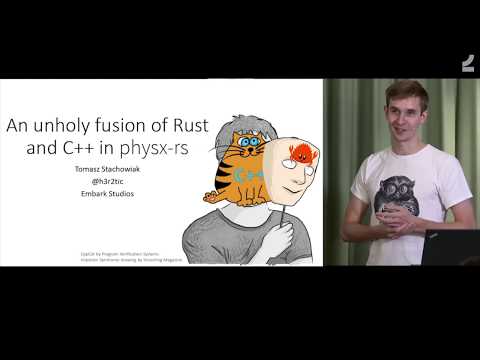
[Tomasz Stachowiak](https://github.com/h3r2tic) did a presentation at the Stockholm Rust Meetup on October 2019 about this project that goes through the technical details of how C++ to Rust bindings of `physx-sys` works:
[](http://www.youtube.com/watch?v=RxtXGeDHu0w)
## Basic usage
```rust
unsafe {
let foundation = physx_create_foundation();
let physics = physx_create_physics(foundation);
let mut scene_desc = PxSceneDesc_new(PxPhysics_getTolerancesScale(physics));
scene_desc.gravity = PxVec3 {
x: 0.0,
y: -9.81,
z: 0.0,
};
let dispatcher = phys_PxDefaultCpuDispatcherCreate(
1,
null_mut(),
PxDefaultCpuDispatcherWaitForWorkMode::WaitForWork,
0,
);
scene_desc.cpuDispatcher = dispatcher.cast();
scene_desc.filterShader = get_default_simulation_filter_shader();
let scene = PxPhysics_createScene_mut(physics, &scene_desc);
// Your physics simulation goes here
}
```
## Examples
### [Ball](examples/ball.rs)
A simple example to showcase how to use physx-sys. It can be run with `cargo run --examples ball`.
```txt
o
o
o
o
ooooooooo
o oo oo
o o
o o o
o oo
o o o
o ooooooo
o o oo oo
o o o oo oo
o o o o ooooooooo
o o o oo oooooooooo oo
```
## How it works
The binding is generated using a custom Rust app that parses the abstract syntax tree of the SDK, and maps the C++ PhysX functions and types to Rust using heuristics chosen specifically for this SDK. It is not a general C++ <-> Rust binding generator, and using it on other projects *will* likely crash and burn.
Since C++ does not have a standardized and stable ABI, it's generally not safe to call it from Rust code; since PhysX exposes a C++ interface, we can't use it directly. That's why `physx-sys` generates both a Rust interface as well as a plain C wrapper. The C code is compiled into a static library at build time, and Rust then talks to C.
In order to minimize the amount of work required to marshall data between the C wrapper and the original C++ API, we generate a **bespoke C wrapper for each build target**. The wrapper is based on metadata about structure layout extracted directly from compiling and running a tiny program against the PhysX SDK using the specific C++ compiler used in the build process.
The build process comprises a few steps:
1. The `pxbind` utility uses `clang` to extract metadata about PhysX functions and types, and generates partial Rust and C bindings as `physx_generated.hpp` and `physx_generated.rs`. Those contain all function definitions, and a small subset of types. It also generates a C++ utility called `structgen` by emitting `structgen.cpp`.
2. `structgen` is compiled against the PhysX SDK, and generates all the remaining type wrappers. For each struct, it queries the size and offset of its members, and generates `structgen_out.hpp` and `structgen_out.rs`. The types are "plain old data" structs which will perfectly match the memory layout of the C++ types.
3. All the generated C types are compiled together to form `physx_api`, a static library for Rust to link with.
4. The Rust wrapper is compiled, and linked with PhysX and the C wrapper.
Steps *2..4* are performed completely automatically from within `build.rs`, while step *1* is only necessary when upgrading the PhysX SDK or modifying the generator. As such, building and running `pxbind` is a manual task, and is currently only supported on \*nix systems.
## License
Licensed under either of
* Apache License, Version 2.0, ([LICENSE-APACHE](LICENSE-APACHE) or )
* MIT license ([LICENSE-MIT](LICENSE-MIT) or )
at your option.
Note that the [PhysX C++ SDK](https://github.com/NVIDIA-Omniverse/PhysX) has its [own BSD 3 license](LICENSE-BSD).
### Contribution
Unless you explicitly state otherwise, any contribution intentionally
submitted for inclusion in the work by you, as defined in the Apache-2.0
license, shall be dual licensed as above, without any additional terms or
conditions.